Quick Answer / Expert Engineering Verdict: To guarantee a 25-year waterproof solar installation on an asphalt composition shingle roof, EPCs must never rely on surface-applied caulk alone. Industry best practice requires rafter-mounted aluminum flashing kits paired with heavy-duty stainless steel lag bolts (minimum 5/16" diameter) anchored directly into the structural wooden rafters. The aluminum flashing plate must slide strictly beneath the upper course of shingles and utilize a compressed EPDM rubber sealing cone around the lag bolt, creating a multi-barrier water-shedding defense that meets UL 441 and ASCE 7 wind uplift standards.
Across North America and parts of Europe, asphalt composition shingles cover over 70% of residential and light-commercial pitched roofs. While shingle roofs are relatively easy for solar crews to walk on compared to brittle clay tiles, they present a deceptive waterproofing challenge: asphalt shingles are not a monolithic waterproof membrane—they are a layered, gravity-fed water-shedding system.
Driving dozens of lag bolts through an asphalt roof without understanding shingle overlapping mechanics, thermal expansion, and rafter pull-out loads is the fastest way to trigger callbacks, rot wooden roof decking, and void homeowner insurance policies.
As a global structural engineering manufacturer, Xiamen Sunforson Power Co., Ltd designs precision-flashed mounting hardware built to integrate seamlessly with both 3-tab and architectural (dimensional) shingles. In this technical whitepaper, we compare rafter-mounted versus deck-mounted attachment engineering, explain the physics of dual-stage flashing, and outline the exact installation standards for zero-leak performance.
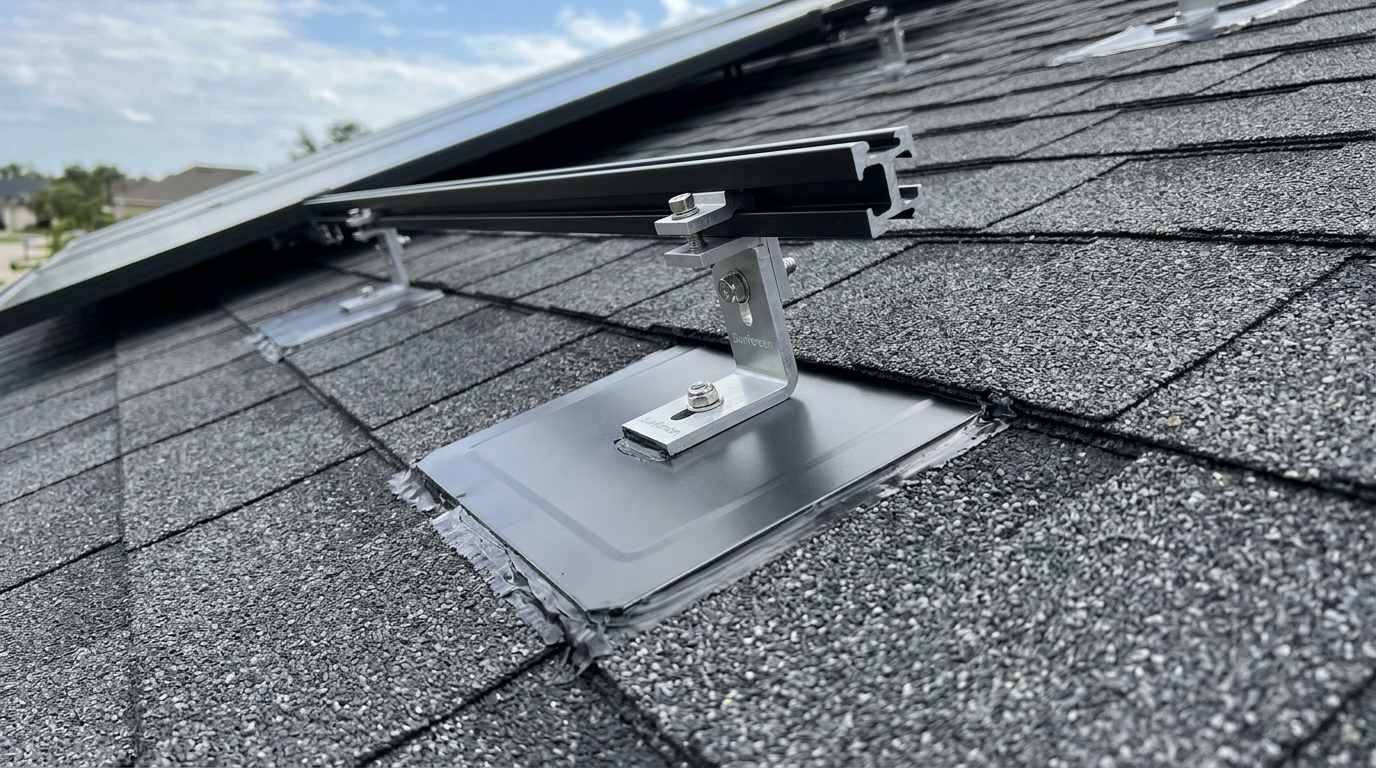
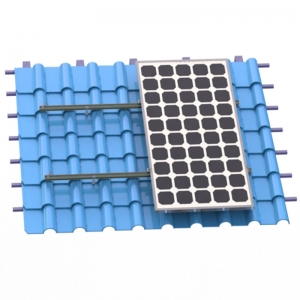
Figure 1: SunRack aluminum flashing L-foot assembly installed beneath the upper course of asphalt shingles
1. Rafter-Mounted vs. Deck-Mounted Attachments: Structural Load Paths
When specifying waterproof asphalt shingle roof solar flashing mounts, the first engineering decision is determining where the structural load will terminate: directly into the heavy framing rafters or into the thinner plywood/OSB roof decking.
- Rafter-Mounted Systems (The Structural Standard): A single heavy-duty SUS304 stainless steel lag bolt (typically 5/16" × 3" or 4") penetrates through the shingle and OSB decking, embedding at least 2.5 inches directly into the center of the structural wooden rafter or truss chord. This provides immense pull-out resistance (often exceeding 1,000+ lbs per attachment depending on wood species) and allows wider horizontal rail spans (up to 6 feet / 1.8m) in standard wind zones.
- Deck-Mounted Systems (Sheathing-Only): Instead of hunting for rafters, deck-mounted brackets use 4 to 6 smaller wood screws driven solely into the 1/2" or 5/8" OSB/plywood roof sheathing. While this speeds up layout time and eliminates missed rafter holes ("shiners"), deck-mounted attachments have significantly lower individual pull-out capacity. Consequently, EPCs must install far more roof penetrations per array, and deck-mounting is generally restricted in high-wind hurricane zones or heavy snow regions.
2. The Physics of Waterproofing: Why Aluminum Flashing Beats Sealant
A common shortcut taken by low-tier installers is bolting a bare L-foot directly on top of the shingle and smearing a thick layer of silicone caulk around the base. Under direct UV exposure and 50°C daily roof temperature swings, exposed sealant will inevitably dry out, shrink, and crack within 3 to 5 years.
Sunforson’s structural pitched roof PV racking systems eliminate this failure point through a three-layer mechanical waterproofing architecture:
- Layer 1 — Elevated Aluminum Flashing Plate: A corrosion-resistant AL5052 or AL6005 aluminum sheet slides up under the adhesive tar strip of the upper shingle course. Any rainwater running down the roof flows seamlessly over the top of the aluminum plate and back onto the lower shingle, completely bypassing the bolt hole underneath.
- Layer 2 — Elevated Boss & EPDM Compression Cone: Our flashing plates feature a raised, stamped dome (boss) around the bolt penetration. Even if wind-driven rain flows sideways across the flashing, it cannot pool around the hole. A thick, UV-stabilized EPDM rubber washer sits under the stainless steel L-foot, compressing tightly against the raised boss when torqued down.
- Layer 3 — Hidden Sub-Flashing Sealant: A U-shaped bead of roof-compatible polyurethane or polyether sealant is applied on the underside of the flashing plate before sliding it into place. Shielded completely from UV radiation by the aluminum sheet, this hidden gasket remains elastic for decades.
Technical Matrix: Shingle Roof Solar Attachment Methods
| Engineering Metric | Rafter-Mounted Flashed L-Foot | Deck-Mounted (OSB Sheathing) | Rail-Less Shingle Mount |
|---|---|---|---|
| Uplift / Pull-Out Strength | Very High (Anchored in structural rafter) | Moderate (Limited by plywood thickness) | High (If rafter-mounted) |
| Penetrations per Array | Low (Wider rail spans possible) | High (Requires denser attachment grid) | Moderate to High |
| Uneven Roof Tolerance | Excellent (Vertical L-foot slots level the rail) | Good (When paired with rails) | Poor (Panels mirror roof waves) |
| Wire Management & Airflow | Superior (Rails elevate panels & hide cables) | Superior (With standard rails) | Tight (Less under-module cooling) |
3. Field Installation Protocols: Pilot Holes, Sealant, and Ice Dams
Even the highest-grade aluminum flashing will fail if field crews ignore basic carpentry and roofing physics. EPC project managers should enforce three strict QA/QC checkpoints on every shingle roof:
- Always Drill Pilot Holes: Driving a 5/16" lag bolt directly into dry, aged Douglas Fir or Southern Yellow Pine rafters without a pilot hole (typically 7/32") will split the wood grain. A split rafter loses over 50% of its structural pull-out capacity, creating a silent failure point during high winds.
- Never Break Shingles in Cold Weather: Asphalt shingles become extremely brittle when ambient temperatures drop below 5°C (40°F). Forcing a pry bar under cold shingles to slide in a flashing plate will snap the shingle tabs. Schedule installations during warmer midday hours or gently warm the tar strip before lifting.
- Respect Ice Dam Zones: In snowy climates, melting snow refreezes at the cold roof eaves, forcing liquid water uphill underneath the shingles. Never install roof penetrations within the bottom 3 feet (approx. 1 meter) of the roof eave, and ensure the flashing plate extends well past the nail line of the shingle course above it.
4. Grounding Integration and Roof Replacement Alternatives
Because residential and light-commercial shingle arrays sit directly above occupied living or working spaces, electrical safety codes (NEC 690 / UL 2703) are strictly enforced. Using integrated grounding mid-clamps and understanding how the grounding lug works on the solar mounting system ensures that every anodized aluminum rail and panel frame is continuously bonded to earth without running excessive copper wire across the shingle surface.
When to Replace Instead of Retrofit: If an asphalt shingle roof is already over 15 years old, curling at the edges, or losing significant protective granules, installing a 25-year solar array on top of it is financially unwise—removing and reinstalling the solar panels later for a roof replacement will cost thousands of dollars. For aging roofs or new commercial builds, developers should consider replacing the roof envelope entirely with architectural BIPV solar mounting structures that serve as both the power plant and the primary waterproof roof.
Frequently Asked Questions (FAQ) for Shingle Roof Solar EPCs
Q1: What should an installer do if they drill a hole and miss the rafter?
Missed rafter holes (commonly called "shiners") must never be left open or plugged with a random screw. Immediately inject a roof-grade polyurethane sealant completely into the missed hole, and if the hole is outside the coverage area of the final aluminum flashing plate, slide a separate small aluminum sub-flashing sheet under the shingle above it to guarantee zero water intrusion.
Q2: Are Sunforson's shingle flashing kits compatible with both 3-tab and architectural shingles?
Yes. Our AL5052/AL6005 flashing plates are engineered with a sleek, low-profile thickness (typically 1.0mm to 1.2mm) that slides cleanly beneath both single-layer 3-tab shingles and thicker, multi-layered architectural (dimensional) shingles without lifting or buckling the overlying shingle course.
Q3: Does installing a flashed solar mounting system void the asphalt shingle manufacturer's warranty?
Major shingle manufacturers (such as GAF, Owens Corning, and CertainTeed) do not automatically void their material warranties when solar is installed—provided the racking system uses UL-certified mechanical flashing, proper sub-flashing sealant, and does not damage the surrounding shingles. Using SunRack's precision-flashed L-feet protects both the roof and the warranty.
Eliminate Roof Leak Callbacks with Precision-Flashed Hardware
Protect your EPC reputation and accelerate residential and commercial shingle installations. Partner with Xiamen Sunforson Power Co., Ltd for pre-assembled, UL-compliant shingle roof flashing kits and high-strength aluminum rails.
Request product samples or a project-specific structural quotation today:
info@sunforson.com