Quick Answer / Expert Engineering Verdict: To successfully deploy an Agrivoltaic (Agri-PV) solar farm without destroying crop yields, EPCs must abandon standard ground mount geometries. An engineered Agri-PV racking system requires elevated structural clearance (minimum 2.5m to 4.0m) to accommodate heavy agricultural machinery, ultra-wide column spans (up to 8 meters) to maximize plowable land, and optimized panel spacing to ensure adequate Photosynthetically Active Radiation (PAR) reaches the vegetation below. Because of the massive aerodynamic uplift caused by these elevated canopies, robust hot-dip galvanized steel pile foundations and rigorous Finite Element Analysis (FEA) are mandatory.
The global renewable energy transition is facing a critical geographical bottleneck: the "Food vs. Fuel" debate. As massive utility-scale solar farms consume thousands of acres of prime agricultural land, local governments and farming communities are pushing back. The solution to this crisis is Agrivoltaics (Agri-PV)—the simultaneous use of land for both solar photovoltaic power generation and agriculture.
However, from an EPC (Engineering, Procurement, and Construction) perspective, deploying an Agri-PV project is exponentially more complex than a standard open-field solar farm. You are no longer just building a power plant; you are engineering a micro-climate canopy for living crops while accommodating massive, moving farming equipment.
As a premier global manufacturer of advanced PV structures, Xiamen Sunforson Power Co., Ltd engineers high-clearance structural brackets specifically designed to harmonize steel, silicon, and soil. In this deep-dive technical whitepaper, we decode the structural mechanics, aerodynamic challenges, and foundation requirements of building a profitable Agrivoltaic racking system.
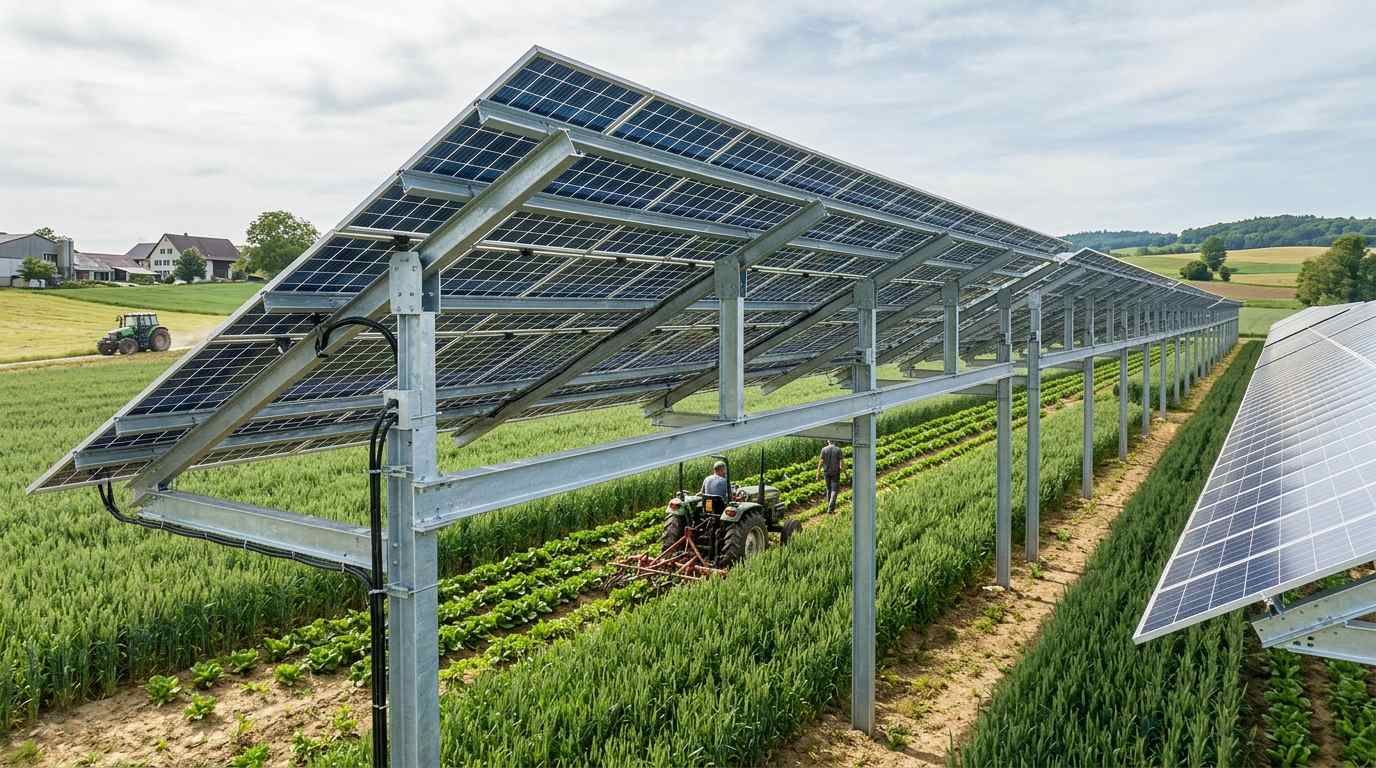
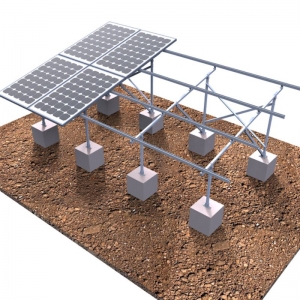
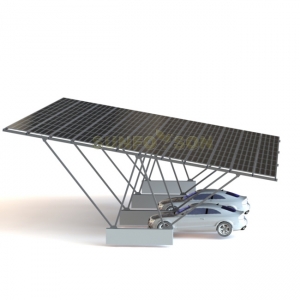
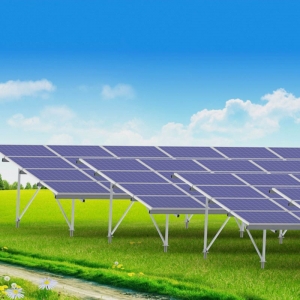
Figure 1: SunRack high-clearance Agri-PV structure designed to allow tractor navigation and optimal crop sunlight
1. Structural Geometry: Ground Clearance and Column Span
A traditional solar farm is designed to be as low to the ground as safely possible (usually 0.5m clearance) to save on steel costs and reduce wind resistance. In an Agri-PV system, this logic is entirely inverted.
The Machinery Clearance Rule: Modern agriculture relies on combine harvesters, automated tractors, and irrigation booms. To allow these machines to operate seamlessly without crashing into the solar array, Sunforson engineers our customized agricultural solar ground mount structures with a minimum lower-edge clearance of 2.5 meters to 4.0 meters, depending on the specific crop type (e.g., vineyards vs. wheat fields).
Ultra-Wide Column Spacing: Standard solar racks have vertical legs every 3 to 4 meters. In a farming environment, a dense forest of steel legs prevents tractors from plowing in straight lines and destroys tillable acreage. By utilizing ultra-high-tensile Q355B galvanized steel for the horizontal purlins and main beams, our engineering team can expand the span between vertical columns up to 6.0 to 8.0 meters, creating massive, unobstructed driving lanes for farm machinery.
2. Conquering Extreme Aerodynamic Uplift
Elevating a massive plane of glass 4 meters into the air creates a terrifying aerodynamic phenomenon. The solar array essentially becomes a giant airplane wing. During a severe storm, the wind traveling underneath the panels generates immense aerodynamic uplift, attempting to rip the entire structure out of the soil.
To ensure the system survives a 25-year lifespan (and extreme wind loads up to 60m/s), standard C-channel posts are insufficient. We deploy the same heavy-duty engineering principles used in our heavy-duty commercial solar carport canopies. This involves utilizing massive H-beam or oversized rectangular hollow sections (RHS) for the main pillars, deeply embedded into the earth, and reinforced with diagonal cross-bracing to prevent lateral sway and structural twisting.
3. Managing the Shadow Footprint: Light Transmission (PAR)
The biological success of an Agri-PV project relies on Photosynthetically Active Radiation (PAR)—the specific spectrum of light crops need to grow. If the solar racking is too dense, the crops will die from light starvation.
Sunforson addresses this through mathematically optimized array modeling. Rather than packing panels edge-to-edge, the structural rails are designed to accommodate checkerboard panel layouts, expanded inter-row spacing, and semi-transparent bifacial modules. Furthermore, our engineers calculate the sun's trajectory to ensure the "shadow footprint" moves dynamically across the field throughout the day, ensuring that no single patch of soil is permanently shaded.
Note on Greenhouses: For enclosed agricultural setups, we utilize a specialized variant of our elevated pitched roof PV brackets. These structural grids replace the traditional glass or plastic greenhouse roof with an interlocking array of solar panels and specialized W-rail water channels, providing a 100% waterproof seal while maintaining internal climate control.
Technical Matrix: Standard Ground Mount vs. Agri-PV Structure
| Engineering Parameter | Standard Utility Ground Mount | SunRack Agri-PV Mounting System |
|---|---|---|
| Ground Clearance | 0.5m to 0.8m (Low Profile) | 2.5m to 4.0m+ (Machinery Clearance) |
| Column Span (East-West) | 3.0m to 4.0m | 6.0m to 8.0m (Maximizes plowable land) |
| Structural Steel Profile | Standard C-Channel or U-Channel | Heavy-duty H-Beam or RHS with Cross-Bracing |
| Soil Interaction | Compacted earth acceptable | Deep ramming to preserve topsoil hydrology |
4. Foundation Integrity: Protecting the Topsoil
In an agricultural setting, the topsoil is a sacred asset. Pouring massive concrete block foundations is generally strictly prohibited in Agri-PV projects because concrete permanently destroys the tillable earth, disrupts natural soil hydrology, and leaches alkaline compounds into the crops.
The mandatory engineering solution is Direct Ramming Piles or Galvanized Ground Screws. These foundations are driven deeply into the subsoil without displacing the nutrient-rich topsoil layer. Furthermore, Sunforson guarantees that our hot-dip galvanization process uses high-purity zinc, ensuring that heavy metals do not leach into the surrounding groundwater over the 25-year lifecycle of the array, maintaining full compliance with strict environmental and agricultural protection laws.
Frequently Asked Questions (FAQ) for Agri-PV Developers
Q1: What happens if a tractor accidentally hits a support column?
This is a real risk in Agri-PV. Because we design the main pillars using heavy-duty H-beams, they possess immense lateral impact resistance. Additionally, we highly recommend EPCs install bright yellow, high-visibility collision bollards or concrete protective sleeves around the base of each pillar located in active tractor driving lanes.